‘Is This Happyland?’
To gain entrance to the Richmond Art Gallery’s new exhibition Ongoing / Pacific Crossings , one must make one’s way through a host of white dress shirts, each coated thickly in layers of paint.
The shirts function as an archway of sorts, shepherding visitors into the space. With its reference to torii, traditional Japanese archways that mark the transition from the mundane to sacred, the shirts are a fitting way to enter an art gallery. What other place mixes the sacred, the profane and even the absurd into an encompassing whole?
The work of Mineki Murata introduces the exhibition, and it combines all of these aspects. Born in Gunma, Japan, and currently based in Tokyo, Murata’s body of work is just that, a body, emphasizing not only the corporeal, physical nature of live performance, but also the lingering effects of the experience, caught and made permanent in marks, colour and gesture.
The title of Murata’s My Back Talk references the Japanese idiom of “speaking with your back,” meaning to let actions speak louder than words, but it could also incorporate the Western version of the phrase, meaning to give somebody lip and to stand up authority, whether in the form of one’s parents or the police.
In the video documentation of the performance that took place at the Richmond gallery, Murata twists and contorts his body, reaching backwards, grunting loudly and scratching coloured marks on the white cotton of a men’s dress shirt. In the background, onlookers, including a fair number of younger kids, watch. Some seem a bit confused, while others are looking on in evident glee. It’s a reminder that kids make some of the best audiences for contemporary art.
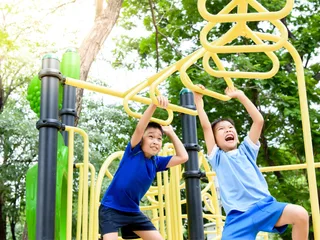
Ongoing / Pacific Crossings is, in some fashion, a natural fit for children, who are innate connoisseurs of the weird and wild, unafraid of experiences that stretch and warp the fabric of reality and consciousness. After all, play itself is a serious business, incorporating experimental takes on big ideas, but also opening body and mind to let imagination do its thing. Inside this freewheeling space, all things are possible.
Taking this approach to the show is useful, eschewing the more academic and theory-based interpretations to simply see the work.
With almost a dozen artists working in a dizzying array of mediums, the exhibition also includes a number of short films housed in a black box theatre. Co-curated by independent Makiko Hara and Nozomu Ogawa, the director of Tokyo’s Art Center Ongoing, or ACO , the show comes out of seven years of meetings, gallery visits and dialogue.
The mandate of ACO is to provide a place for artists to make work, hang out and discover each other — in essence, to offer a hub for creative exchange. Across the ocean, the Richmond Art Gallery is doing something similar.
5News aggregated this summary from the outlet’s public feed. The full article, with all the context, is on thetyee.ca — the content belongs to The Tyee.