Who's behind viral online posts fuelling a crisis over migration in Europe?
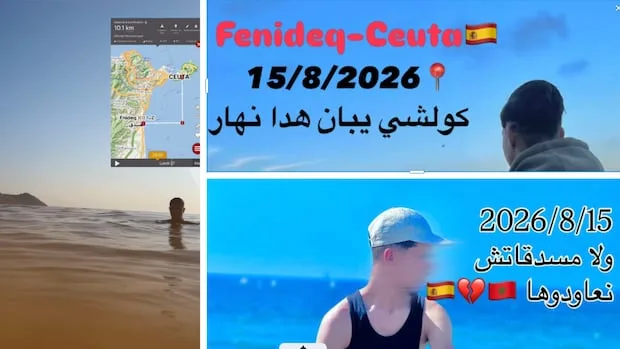
In the days leading up to the largest mass arrival of migrants to Europe in recent years, a short video posted to Instagram garnered 1.4 million views.
It shows a young man submerged up to his neck in water before panning to land in the distance. In the top-right corner, a map traces a sea route from Fnideq, Morocco, to Ceuta, a Spanish enclave on the northern tip of Africa. Responding to comments later, the account holder claimed "we've arrived."
The video was one of many viral posts on Instagram, TikTok and other platforms that appear to have helped mobilize at least two waves of irregular migration from Morocco into Ceuta. The latest, attempted on August 15, led to dozens of arrests.
The accounts belong to several online communities that are part of a broader ecosystem focused on migration-related culture — music, memes and imagery. Some tap into, and appear to be trying to profit from, the desperation of mostly African and Middle Eastern youth seeking better lives abroad.
There is disagreement among governments and organizations over whether a single entity was behind what happened in Ceuta or whether migration was weaponized for geopolitical aims. What is clear is that misinformation, amplified by multiple online communities, helped drive this summer's waves toward Ceuta.
CBC's visual investigations team, with assistance from Sebastian Vandermeersch of the investigative collective Bellingcat, identified multiple social media accounts, particularly on Instagram, that were active ahead of the first wave on July 30.
The surge in posts was initially triggered by misinformation suggesting a Spanish court ruling meant the country would no longer turn away migrants arriving by sea. Many faceless accounts subsequently began promoting the idea the crossing was possible, using similar language and images. Some posts garnered millions of views.
The consequences were significant: more than 72,000 people crossed the border on July 30, overwhelming authorities in Ceuta and setting off a political crisis in Europe.
The vast majority of those who crossed at the end of July have since returned to Morocco, but at least 5,000 remain in Ceuta, many living on a beach with help from charities. Nearly 100 people died trying to make the crossing.
It is a stark illustration of how misinformation and manipulation can have "real-world impact" when amplified across online communities and directed at people desperate for answers, said Moustafa Ayad, executive director for Africa, the Middle East and Asia at the Institute for Strategic Dialogue. His team has tracked the surge in social media activity over the past month.
One Instagram video titled "the shortest distance," viewed more than 320,000 times, shows a reinforced fence topped with barbed wire and marks the Spanish and Moroccan sides with their respective flags. Large red and yellow arrows — the colours of the Spanish flag — point to a specific section.
5News aggregated this summary from the outlet’s public feed. The full article, with all the context, is on www.cbc.ca — the content belongs to CBC World.