Tiny workshop knocks the socks off Aussie manufacturing
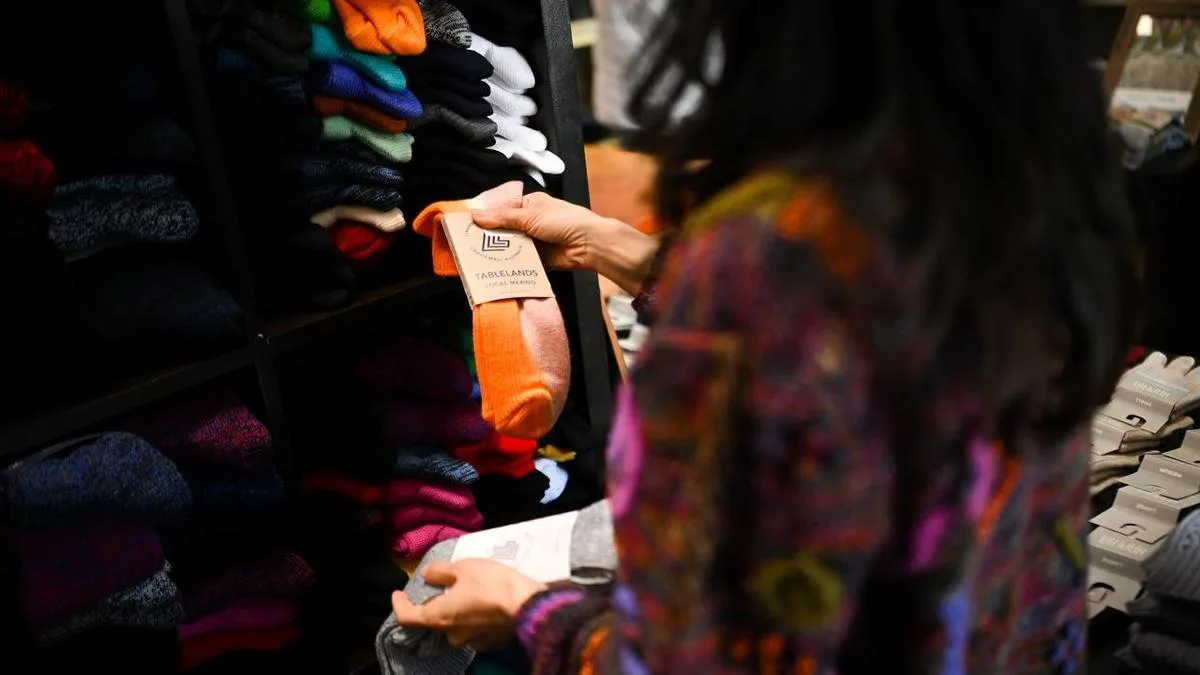
Down the block from the Horse and Hound Hotel and across from a farm supply shop doing a roaring trade in sheep drench, sits one of Australia's last woollen sock factories.
Lindner Socks produces 40,000 pairs every year from a nondescript shopfront on Crookwell's main drag, a quiet captain of industry in the heart of NSW Southern Tablelands sheep-grazing country.
The air in the wood-panelled factory is rich with the warm scent of oil, which keeps rows of knitting machines humming with a rhythmic clickety-clack.
The half-century-old knitters are equipped with a ring of needles that follow a pattern, hooking, spinning and whirring to form tightly crocheted and cosy tubes of Merino wool.
Socks come off the machines in lengths like strings of sausages, ready to be cut and finished by hand.
"The pattern is set up like an old printer," sock maker Andrew Lindner tells AAP over the thrum of the machines on the factory floor.
A 10th-generation sock maker, Mr Lindner is carrying on the tradition of his father and German forebears.
Their surname comes from the German word linde, meaning lime, for a family who lived near a citrus grove.
While life has changed markedly since 1700s Germany, Mr Lindner says consumers are increasingly looking to the past for quality and connection in their clothing.
"Humans are finding we've had everything at our fingertips at a cheap price but it's not quite doing what we want.
"We want to go back to a farm, see stuff come out of the ground, taste things, get back to the natural good and reconnect."
The quirks of the nation's economy come to life inside the walls of the compact Crookwell factory.
Lindner is an outlier in textiles, with about 97 per cent of clothes sold in Australia made offshore.
Free trade policies introduced from the 1980s were the death knell for local textile manufacturing, while capabilities to scour and spin fibres on a large scale also disappeared.
5News aggregated this summary from the outlet’s public feed. The full article, with all the context, is on www.perthnow.com.au — the content belongs to PerthNow.