When hundreds of animals die from bird flu, what happens next?
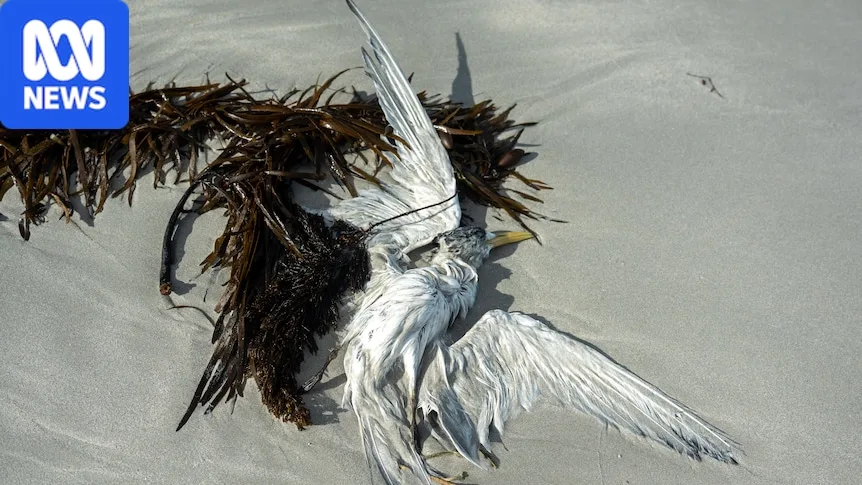
In a matter of weeks, Australia has moved from its first mainland H5N1 bird flu detections to hundreds of confirmed cases and several wildlife mass mortality events from the disease.
A series of mass deaths off South Australia, including more than 1,000 terns , marked an important shift in Australia's encounter with H5N1 bird flu.
Federal authorities warn they won't be the last, although it is far too early to know what exactly comes next.
But what we do know is mass mortality events are an increasing challenge for ecologists and wildlife managers.
Warning: This story contains images that some readers may find distressing.
Mass mortality events are sudden episodes in which unusually large numbers of animals die over a relatively short period, often near each other.
Disease is one cause. But they can also be triggered by heatwaves, drought, fire, floods, harmful algal blooms, starvation and other environmental extremes.
Besides bird flu mortalities, there has recently been a mysterious mass death of pelicans at the Menindee Lakes, NSW, and the disappearance of cuttlefish from the Upper Spencer Gulf, SA.
Mass mortality events don't simply remove animals from ecosystems. They create masses of dead and decaying flesh (carrion), redistribute nutrients, attract scavengers and change interactions between species.
Yet despite their scale, we know surprisingly little about these events and their longer-term ecological consequences.
We rarely know when or where one will occur, making it difficult to collect the "before" data ecologists normally rely on.
Marine heatwaves, fires, droughts and other extreme events are already capable of killing wildlife on enormous scales.
Mass death events are expected to become more frequent as weather and climate extremes intensify .
H5N1 bird flu adds another potential driver of mass mortality to Australian ecosystems.
5News aggregated this summary from the outlet’s public feed. The full article, with all the context, is on www.abc.net.au — the content belongs to ABC News Australia - Technology.